

Hollywood Strike Photographs
2023
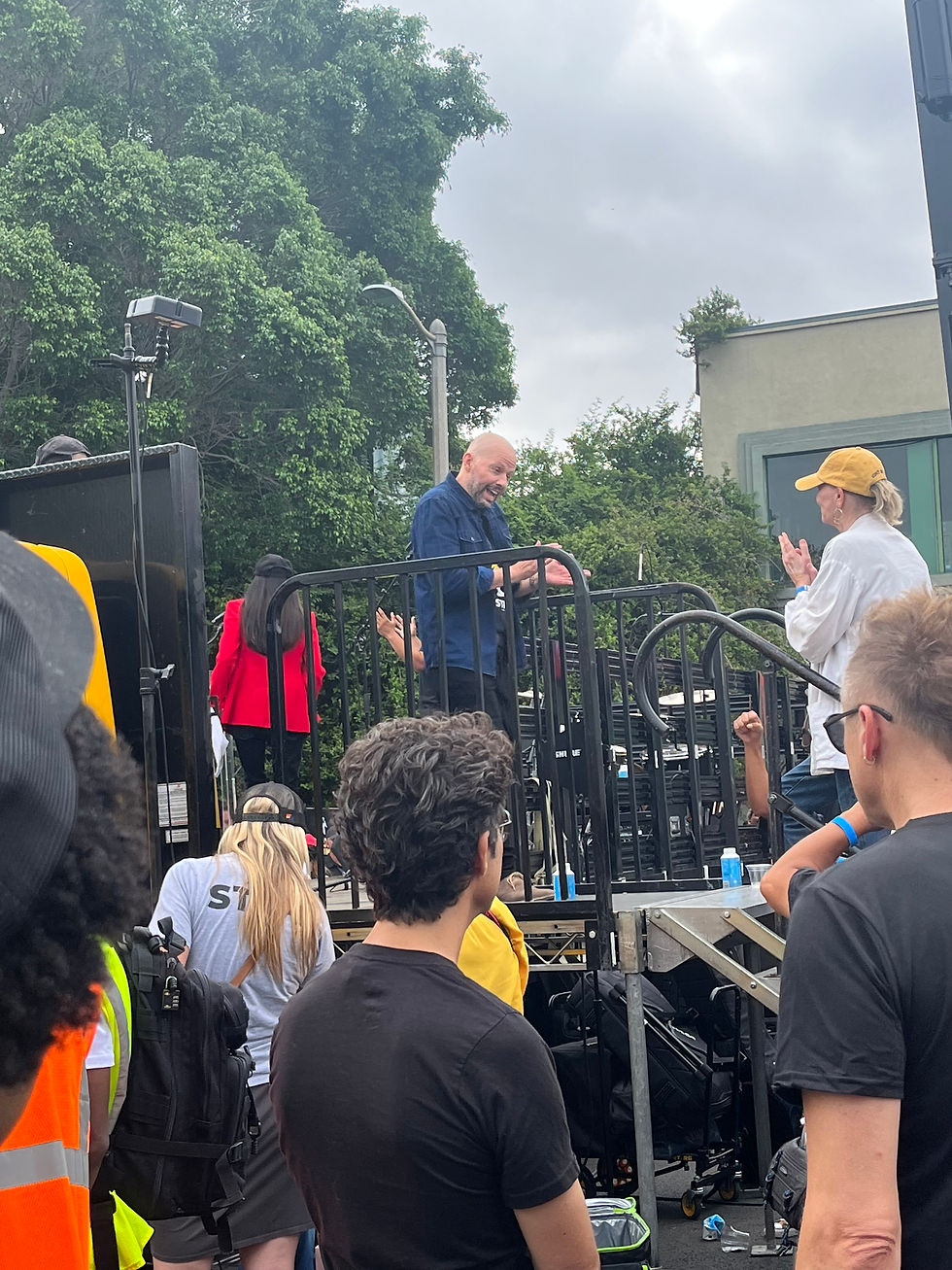
Images taken by Matthew M. Dominguez throughout the 2023 Hollywood labor strikes, documenting WGA and SAG-AFTRA rallies, picket lines, strike signs, and studio-gate demonstrations across Los Angeles. Several images capture the public visibility of the strikes, including appearances by SAG-AFTRA President Fran Drescher and actor Jon Cryer alongside union members and supporters.
"We’re Not Dumbo — We Won’t Work for Peanuts" Poster
1987
Poster used during the 1987 voice actors’ strike, using animation imagery and humor to criticize unfair compensation for performers working in television animation.
Screen Actors Guild–American Federation of Television and Radio Artists (SAG-AFTRA) Archives.
"Screen Actors on Strike in TV Animation" Poster
1987
Poster used during the 1987 voice actors’ strike, which focused on compensation and recording conditions for performers working in television animation.
Screen Actors Guild–American Federation of Television and Radio Artists (SAG-AFTRA) Archives.
"End Mickey Mouse Bargaining" Poster
1987
Poster used during the 1987 voice actors’ strike, using familiar animation imagery to criticize studio bargaining practices and call attention to unfair treatment of performers in television animation.
Screen Actors Guild–American Federation of Television and Radio Artists (SAG-AFTRA) Archives.
"Actors Support the Writers Guild" Poster
1981
Detail of a Screen Actors Guild poster expressing solidarity with the Writers Guild of America during the 1981 writers’ strike, a dispute connected to compensation from emerging markets such as pay television and home video. Photographed as displayed in the original physical exhibition.
Screen Actors Guild–American Federation of Television and Radio Artists (SAG-AFTRA) Archives.
"The Writer’s Guild Strikes!" Poster
1988
Detail of a Writers Guild of America poster from the 1988 WGA strike, the longest strike in WGA history and a dispute connected to residuals, foreign television markets, and creative control. Photographed as displayed in the original physical exhibition.
Screen Actors Guild–American Federation of Television and Radio Artists (SAG-AFTRA) Archives.
"AFTRA Strike!" Magazine
1979
Detail of an AFTRA publication documenting the 1978-1979 Commercial Strike, photographed as displayed in the original physical exhibition.
Screen Actors Guild–American Federation of Television and Radio Artists (SAG-AFTRA) Archives.
"A Strike Retrospective"
1980-1981
Detail of a Screen Actors Guild publication documenting the 1980 actors’ strike, photographed as displayed in the original physical exhibition.
Screen Actors Guild–American Federation of Television and Radio Artists (SAG-AFTRA) Archives.
“Actors’ Equity Association Wins Opening Skirmish” Newspaper Clipping
1929
Article describing an early victory in Actors’ Equity’s campaign for recognition and working conditions in Hollywood motion-picture production.
Screen Actors Guild – American Federation of Television and Radio Artists (SAG-AFTRA) Archives.
“Equity’s Cat Out of Bag” Newspaper Clipping
1929
Article discussing Actors’ Equity’s campaign for recognition and working conditions in Hollywood motion-picture production.
Screen Actors Guild – American Federation of Television and Radio Artists (SAG-AFTRA) Archives.
“Production Humming Again at Studios Following Strike” Newspaper Clipping
1929
Article reporting the return of Hollywood studio production after the failed Actors’ Equity strike.
Screen Actors Guild – American Federation of Television and Radio Artists (SAG-AFTRA) Archives.

Gallery II: Strikes that Reshaped Hollywood
This exhibition provides a visual retrospective of pivotal moments when labor movements reshaped the course of Hollywood history. From the first picket lines of the silent era to the complex negotiations of the digital present, these artifacts reveal a persistent fight for recognition, fair compensation, and professional dignity. The objects gathered here are more than just historical markers. They are the physical remains of a struggle that continues to reshape the industry today.
From Recognition to Residuals
EXHIBIT NOTES
This gallery examines several major strikes and labor disputes that shaped Hollywood’s film, television, and animation industries. It begins with a broad overview of strike materials from different periods of Hollywood history, showing how workers used picket signs, union publications, and public protest to challenge studio practices. The gallery then focuses on three major conflicts: the 1941 Disney Animators’ Strike, the Conference of Studio Unions Hollywood Studios Strikes, and the 2007–08 Writers Guild of America Strike. Together, these sections show how Hollywood labor disputes moved from basic recognition and workplace protections toward recurring battles over residuals, new media, and creative control.


1929 Actors' Equity Strike
The 1929 Actors’ Equity strike represented an early attempt to organize Hollywood performers before the founding of the Screen Actors Guild. Actors’ Equity, which represented stage actors, sought recognition in the motion-picture industry as sound film transformed Hollywood production. The effort ultimately failed, but it exposed the growing tension between performers and producers over contracts, working conditions, and union recognition. A few years later, in 1933, the Screen Actors Guild formed and became the primary union representing film actors, while Actors’ Equity remained centered on stage performance.
1941 Looney Tunes Lockout
The 1941 Looney Tunes lockout reflected the spread of animation labor organizing beyond Disney and into other major animation studios. As the Screen Cartoonists Guild expanded its influence, animators pushed for recognition, improved pay, and fairer treatment within a field often treated as secondary to live-action filmmaking. The dispute at Leon Schlesinger Productions showed that animation workers were part of the same broader labor movement reshaping Hollywood, even when their work was hidden behind cartoon characters and studio branding.


1978-1979 Commercial Strike
The 1978–79 commercial strike involved SAG and AFTRA members seeking better compensation for work in television advertising. As commercials became an increasingly profitable part of the entertainment economy, performers challenged how advertisers and producers compensated actors whose appearances continued to circulate on television. The strike reflected a larger shift in Hollywood labor disputes: workers were no longer fighting only over wages at the time of production, but also over how they should be paid when their work continued to generate value after the original recording.
1980 Actors' Strike
The 1980 actors’ strike grew out of similar concerns over compensation in new and expanding markets, especially pay television and home video. SAG and AFTRA sought a share of revenue from media formats that were changing how films and television programs reached audiences. The strike showed how technological change repeatedly forced Hollywood unions to renegotiate older labor agreements. As studios found new ways to profit from existing work, performers argued that their contracts needed to reflect those new sources of revenue.

Did You Know?
The shortest Hollywood strike is the 1987 Directors Guild of America strike. The strike lasted 3 hours and 5 minutes in the East and only 5 minutes in the West before a deal was reached with the AMPTP.

1981 Writers Guild Strike
The 1981 Writers Guild strike followed closely after the 1980 actors’ strike and reflected many of the same concerns. Writers wanted compensation from emerging markets such as videocassettes and pay television, where studios and producers were finding new revenue beyond the original broadcast or theatrical release. The strike demonstrated how residuals had become a central issue for creative labor. Writers argued that if their work continued to generate profit in new formats, they should receive a fair share of that value.
1979 & 1982 Animators' Strike
The 1979 and 1982 animators’ strikes revealed the growing threat of runaway production in television animation. As studios began sending animation work overseas, local artists and animators feared the loss of jobs in Los Angeles. In 1979, the Motion Picture Screen Cartoonists Guild won a “runaway clause” that helped protect local employment before work could be subcontracted outside Los Angeles County. However, the 1982 strike ended differently, as studios increasingly shifted television animation and ink-and-paint work overseas. These disputes showed that animation workers faced not only wage and contract issues but also the larger restructuring of the industry itself.

The Future of Labor (2023 & Beyond)
The 2023 Hollywood strikes marked one of the most significant labor moments in recent entertainment history. For the first time since 1960, writers and actors were on strike at the same time, bringing much of the industry to a halt. The disputes centered on many of the same questions that had shaped earlier labor conflicts, such as compensation, residuals, changing technology, and workers' ability to protect their place in an evolving industry.
By 2023, streaming had transformed how films and television shows were produced and distributed. Writers and performers argued that older compensation models no longer reflected the value of their work for streaming platforms. Artificial intelligence also became a major concern, raising questions about authorship, likeness, consent, and the place of human labor in a rapidly changing environment.
The strikes were also part of a broader year of labor unrest across the United States, as workers in many industries challenged employers over similar issues, such as wages and technological change. In Hollywood, picket lines outside studio gates connected the industry’s conflicts to a much longer history of labor protest.
The agreements reached in 2023 did not end these debates. In 2026, both the WGA and SAG-AFTRA returned to negotiations with the AMPTP and reached new four-year agreements, replacing the three-year contract that had often structured Hollywood. The longer terms suggested an effort to create greater stability in a tumultuous climate. Still, the same concerns remained at the center of negotiations, such as streaming compensation, healthcare, AI, residuals, and the future of entertainment work.


1987 Voice Actors Strike
The 1987 voice actors' strike focused on performers working in television animation. Voice actors sought better pay structures, including higher minimum session fees and additional compensation when performers were required to voice multiple characters. The strike also drew attention to the physical demands of voice work, especially the strain placed on performers during long recording sessions. By using familiar cartoon imagery in protest materials, the strike made animation labor visible to the public and challenged the assumption that animated entertainment was separate from serious labor issues.
1988 Writers Guild Strike
The 1988 Writers Guild strike became the longest strikes in WGA history, lasting roughly 153 days. The dispute centered largely on residuals from television reruns, foreign markets, and creative control. Writers resisted producers' efforts to reduce or limit residual payments as television syndication and international distribution became increasingly important. The strike reflected a recurring pattern in Hollywood labor history: whenever the industry developed new ways to reuse and profit from creative work, unions fought to make sure workers were included in that economic future.




While not the first labor strike in the animation industry, the 1941 Disney Animators’ Strike became one of the most influential labor conflicts of Hollywood’s Golden Age. By the late 1930s, Disney had become the dominant force in American animation. The success of Snow White and the Seven Dwarfs transformed the studio and raised the artistic ambitions of animated film, but it also intensified the demands placed on animators. Long hours, unpaid overtime, uncertain bonus payments, and unequal treatment created growing tension among many employees. Even though Disney was often considered one of the better animation studios to work for, the company's success did not erase the tensions between studio leadership and the workers who helped build it.
At the center of the conflict was Art Babbitt, one of Disney’s most prominent animators. Although Babbitt was among the studio’s higher-paid artists, he sympathized with lower-paid employees. He became frustrated with the limits of Disney’s in-house employee organization, the Federation of Screen Cartoonists. As the Screen Cartoonists Guild, led by Herbert Sorrell, expanded its organizing efforts in Hollywood, Babbitt joined the Guild and became one of the most visible supporters of unionization at Disney. His support for the Guild was viewed by Walt Disney as a personal betrayal, especially as more employees began to question the studio’s labor practices.
The immediate crisis came when Disney fired Babbitt and sixteen other employees involved in union activity. On May 29, 1941, Disney animators walked out and began picketing the studio. The strike quickly became one of the most visible labor actions in animation history. Strikers used signs, caricatures, humor, and public demonstrations to draw attention to their cause, turning the picket line into a space of both protest and performance. The conflict also exposed deeper divisions within the studio, as workers who remained inside continued production while strikers challenged Disney’s authority outside the gates.
The strike unfolded during a difficult period for the Disney studio. Although Snow White had been a major success, later features such as Pinocchio and Fantasia struggled financially during their initial releases, partly because World War II disrupted international markets. At the same time, Disney was investing in new production facilities and future projects. These pressures made the labor conflict even more dangerous for the company. During the strike, the federal government also became involved. The United States Conciliation Service helped mediate the dispute, while Walt Disney left for South America on a government-supported goodwill tour connected to the Good Neighbor Policy. His absence helped cool tensions and allowed negotiations to move forward.
After nearly four months, the strike ended on September 21, 1941. The settlement included the reinstatement of fired employees, back pay, equalized wages, a clearer salary structure, and a grievance procedure. These gains marked a major victory for the Screen Cartoonists Guild and forced Disney to accept organized labor within the studio. Yet the strike also left lasting wounds. Disney never fully forgave many of those who participated, and several important artists eventually left the company. Some former Disney animators helped shape new animation styles through studios such as United Productions of America, which rejected Disney’s highly realistic style and experimented with more modern, stylized approaches.
The importance of the Disney strike extends beyond one studio. It revealed how animation workers, often hidden behind characters and studio branding, were part of the broader labor struggles reshaping Hollywood. It also exposed the tensions between creative achievement and corporate authority. Disney’s films had created some of the most beloved images in American popular culture. Still, the strike showed that those images were produced by workers who also fought over wages, recognition, respect, and control over their labor. No other labor dispute in animation has so clearly exposed the relationship between unionization, studio power, artistic production, and political rhetoric.
1941 Disney Animators’ Strike
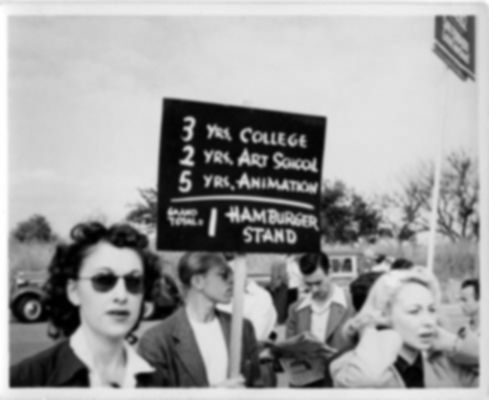
"3 Yrs. College, 2 Yrs. Art School, 5 Yrs. Animation..."
1941
Photograph of Disney animation workers picketing during the 1941 Disney Animators’ Strike. The sign criticized the gap between specialized artistic training and the economic insecurity faced by animation artists.
Motion Picture Screen Cartoonists Guild, Local 839 Collection, Special Collections and Archives, University Library, California State University, Northridge.
Click image to view this item in CSUN Digital Collections.
_edited.jpg)
"Disney Artists Still on Strike"
1941
Strike flyer created during the 1941 Disney Animators’ Strike, emphasizing that the strike and boycott remained active despite rumors to the contrary.
Motion Picture Screen Cartoonists Guild, Local 839 Collection, Special Collections and Archives, University Library, California State University, Northridge.
Click image to view this item in CSUN Digital Collections.

"Disney Unfair"
1941
Strike flyer from the 1941 Disney Animators’ Strike calling for union recognition, reinstatement of fired workers, and a fair contract.
Motion Picture Screen Cartoonists Guild, Local 839 Collection, Special Collections and Archives, University Library, California State University, Northridge.
Click image to view this item in CSUN Digital Collections.


"Cartoonists Like Disney Terms but Ban Willie as Boss"
1941
Article discussing William “Willie” Bioff’s attempted involvement in negotiations during the 1941 Disney Animators’ Strike. Bioff, already associated with corruption and organized crime in Hollywood labor, became a controversial figure whose presence complicated efforts to settle the dispute.
Screen Actors Guild–American Federation of Television and Radio Artists (SAG-AFTRA) Archives.
"Cartoonists Return to Studio as Disney Agrees to Arbitration"
1941
Article discussing a proposed settlement during the 1941 Disney Animators’ Strike and the continued controversy over William “Willie” Bioff’s involvement in negotiations.
Screen Actors Guild–American Federation of Television and Radio Artists (SAG-AFTRA) Archives.
Union recruitment poster designed by studio animators.
Context Note: Studio head's response
In 1947, Walt Disney testified before the House Committee on Un-American Activities and described the 1941 strike as a political attack rather than a legitimate labor dispute. His testimony shows how he rejected the strikers’ criticism of working conditions and framed the conflict around loyalty, reputation, and outside agitation.
The Testimony of Walter E. Disney Before the House Committee on Un-American Activities, 80th Cong. (1947) (statement of Walter E. Disney). Disney Dreamer.
Herbert Sorrell
1945
Photograph of Herbert Sorrell, leader of the Conference of Studio Unions and a major figure in Hollywood labor activism during the 1940s.
Screen Actors Guild–American Federation of Television and Radio Artists (SAG-AFTRA) Archives.
“What’s It All About?” brochure
u.d.
Reverse side of a Conference of Studio Unions brochure listing affiliated Hollywood craft unions involved in the studio labor disputes.
Conference of Studio Unions Collection, Screen Actors Guild–American Federation of Television and Radio Artists (SAG-AFTRA) Archives.
“What’s It All About?” brochure
u.d.
One side of a Conference of Studio Unions brochure explaining the causes of the Hollywood studio strikes, including wages, working conditions, labor board disputes, and public support.
Conference of Studio Unions Collection, Screen Actors Guild–American Federation of Television and Radio Artists (SAG-AFTRA) Archives.
The Hollywood Reporter, “Strike Menaces More Studios"
1946
Front page covering the expanding Conference of Studio Unions strike and the jurisdictional conflict that disrupted Hollywood studio production.
Screen Actors Guild–American Federation of Television and Radio Artists (SAG-AFTRA) Archives.
Page from Flashes from Hollywood!
1947
A page from a Conference of Studio Unions publication documenting the violence, arrests, injuries, and public-relations battle surrounding the Hollywood studio strikes. The publication presented the CSU’s perspective on the conflict, emphasizing police violence, strikebreaking, producer opposition, and the workers’ effort to win public support.
Screen Actors Guild–American Federation of Television and Radio Artists (SAG-AFTRA) Archives.
“Sorrell Says Warner’s Goes on Strike”
1945
Photograph of Herbert Sorrell, leader of the Conference of Studio Unions, speaking during the Hollywood studio labor conflict. The image reflects Sorrell’s role as a central figure in the CSU’s strike activity and its confrontation with the studios and IATSE over control of Hollywood labor.
Screen Actors Guild–American Federation of Television and Radio Artists (SAG-AFTRA) Archives.
By the early 1950s, the CSU had lost much of its power, and its jurisdiction was absorbed into IATSE. The defeat of the CSU strengthened IATSE’s position as the dominant backstage craft union in Hollywood and reshaped labor politics across the studio system. The strikes exposed the divisions within Hollywood labor itself: workers were not only fighting studios, but also rival unions, political accusations, and changing federal labor law. In this sense, the CSU strikes were more than a struggle over who represented set decorators, painters, or carpenters. They were a battle over the future of labor power in Hollywood.
The Defeat of the CSU
Labor Conflict Meets the Red Scare
Anti-communism further weakened the CSU. Sorrell and the CSU faced repeated accusations of communist influence, while Roy Brewer and other anti-communist labor leaders used those charges to undermine the organization. The political climate of the late 1940s made these accusations especially damaging. As the Red Scare intensified, Hollywood labor disputes became entangled with investigations, blacklisting, and loyalty politics. The passage of the Taft-Hartley Act in 1947 also restricted union tactics, including jurisdictional strikes, making it even harder for the CSU to continue its challenge.
The 1945 strike eventually ended after negotiations involving Eric Johnston, the Motion Picture Producers Association, and the American Federation of Labor. The CSU gained recognition for set decorators, but the settlement left other jurisdictional questions unresolved. The truce did not last. In 1946, another CSU-led strike erupted, this time involving painters and carpenters. By then, public opinion and national politics were increasingly turning against disruptive strikes, especially jurisdictional conflicts between unions. The Hollywood labor wars became part of a larger postwar backlash against organized labor.
The Truce Breaks Down
By October 1945, tensions reached a breaking point outside Warner Bros., culminating in what became known as Hollywood Black Friday. CSU picketers attempted to prevent non-striking IATSE workers and strikebreakers from entering the studio, while police and studio security opened the gates. The confrontation escalated into street fighting involving tear gas, fire hoses, clubs, brass knuckles, bottles, and overturned cars. Although no one was killed, dozens were injured, and the violence made the CSU conflict one of the most dramatic labor battles in Hollywood history. The strike showed that Hollywood labor disputes could become public, physical, and deeply divisive.
Hollywood Black Friday
The immediate conflict centered on jurisdiction: which union had the right to represent particular groups of studio workers. The set decorators became a major point of dispute, but the conflict soon drew in other crafts and occupations. The CSU sought to negotiate directly with the studios for better wages and working conditions, while IATSE resisted any loss of authority. Producers often described the conflict as a fight between unions rather than a struggle between labor and management. In practice, however, the dispute revealed how much studio production depended on the organization and cooperation of behind-the-scenes workers.
A Fight Over Jurisdiction
The CSU emerged as an alternative for workers who believed IATSE had failed to adequately represent them. IATSE had been an industry-wide powerhouse since the 1920s. Still, its reputation was damaged by earlier associations with racketeering and organized crime under leaders such as George E. Browne and Willie Bioff. By the mid-1940s, Richard F. Walsh formally led IATSE, but Roy Brewer became one of its most influential Hollywood representatives. Brewer sought to preserve IATSE’s control over studio labor while also presenting himself as an anti-communist force within the industry. Under Herbert Sorrell’s leadership, the CSU offered a more militant challenge to both the studios and IATSE.
A Challenge to IATSE
Conference of Studio Unions (CSU) Strikes


From 1945 to 1947, the Conference of Studio Unions engaged in a series of strikes against the major Hollywood studios. These strikes were not simply one labor dispute, but a prolonged conflict over jurisdiction, representation, and power within the studio system. The CSU challenged the authority of the International Alliance of Theatrical Stage Employees, which had long been one of the most powerful craft unions in Hollywood. While the Disney strike focused on animation labor at one studio, the CSU strikes involved a broader struggle among studio workers, rival unions, producers, police, and political authorities.
The CSU Enters the Fight


In the Crowd: This photograph includes a young Ronald Reagan, then active in Screen Actors Guild leadership, facing away from the speaker (Herb Sorrell).


"Flashes from Hollywood!"
1947
Cover image documenting police and strike activity during the Conference of Studio Unions Hollywood studio strikes.
Screen Actors Guild–American Federation of Television and Radio Artists (SAG-AFTRA) Archives.
Pages from Flashes from Hollywood!
1947
Pages from a Conference of Studio Unions publication documenting the violence, arrests, injuries, and public-relations battle surrounding the Hollywood studio strikes. The publication presented the CSU’s perspective on the conflict, emphasizing police violence, strikebreaking, producer opposition, and the workers’ effort to win public support.
Screen Actors Guild–American Federation of Television and Radio Artists (SAG-AFTRA) Archives.

“Why We Need Your Help!” from Flashes from Hollywood!
1947
Page from a Conference of Studio Unions publication seeking public support during the Hollywood studio strikes and challenging claims that strikers were responsible for violence.
Screen Actors Guild–American Federation of Television and Radio Artists (SAG-AFTRA) Archives.
The Question of New Media
At the center of the strike was a recurring issue in Hollywood labor history: how workers should be compensated when new technology creates new ways to profit from creative work. Earlier disputes had focused on television reruns, pay television, foreign markets, and home video. By 2007, the central question was digital distribution. Writers argued that internet-based media needed to be addressed before studios established a new system without strong labor protections.
Nov 2, 2007
Strike Authorized
Nov 5, 2007
Strike Begins
Nov 26, 2007
Negotiations Resume
Dec 7, 2007
Talks Break Down Again
Jan 25, 2008
Interim Agreements Announced
Feb 12, 2008
Strike Ends
Feb 26, 2008
New Contract Approved
_edited_edited.jpg)
Strike Captains: An Appreciation
Circa 2007–2008
Cover of a Writers Guild of America, West publication documenting the 2007–08 WGA strike and recognizing the strike captains who helped organize and sustain picket lines during the labor dispute.
Writers Guild Foundation Archives
2007–08 Writers Guild of america strike
Contract Negotiations Break Down
Historically, every three years, the Writers Guild of America negotiates its Minimum Basic Agreement with the Alliance of Motion Picture and Television Producers, which represents the major Hollywood studios. In 2007, negotiations broke down over several issues, including DVD residuals, jurisdiction over animation and reality programming, and compensation for “new media,” a term then used for work created for or distributed through emerging digital streaming platforms.

From New Media to Streaming
The 2007–08 WGA strike helped establish digital distribution as a central labor issue in Hollywood. Although the agreement did not settle every question about online compensation, it created an important precedent for later negotiations over streaming, residuals, and the value of creative work in new media markets.
Negotiations Resume
Negotiations resumed and collapsed several times before progress was made in early 2008. Interim agreements with companies such as Lionsgate and Marvel Studios showed that some producers were willing to make separate deals, even as the AMPTP dismissed their broader significance. After more than three months on strike, the WGA reached an agreement to end the strike in February 2008, and members later approved a new three-year contract.
Writers Walk Out
The strike began on November 5, 2007, after WGA members authorized their leadership to call a strike. Writers picketed major studios in Los Angeles, while WGA East members demonstrated in New York. The strike quickly disrupted television production, late-night programming, scripted series, and the wider Los Angeles economy.
Why It Mattered
The strike’s most important victory was WGA jurisdiction over new media. This meant that certain digital productions would require WGA writers and that writers would receive compensation for some forms of digital distribution. The gains did not resolve every issue, but they established an important precedent. The 2007–08 strike showed that digital media was not a side issue; it was becoming central to Hollywood’s future and helped anticipate later conflicts over streaming, residuals, and the value of creative labor.