
Gallery I: Hollywood, Studios, and Unions
The original physical exhibition opened with familiar materials from Hollywood film and television production, including press kits, scripts, a movie score, and a film reel. These materials invited visitors into the recognizable world of Hollywood entertainment, such as films, cartoons, television shows, studios, and creative works that have shaped American popular culture for more than a century.
In the digital version of Gallery I, this introduction now moves beyond Hollywood’s familiar images and into the industrial forces behind them. Rather than focusing on individual production materials that cannot all be reproduced here, this section examines the studios, unions, and legal structures that shaped Hollywood labor history and made the industry both powerful and deeply contested.

Variety Daily Magazine, Screen Actors Guild – American Federation of Television and Radio Artists (SAG-AFTRA) Archives.
Paramount Pictures
One of Hollywood’s “Big Five” studios, Paramount represented the scale and control of the studio system, which relied on major production facilities, long-term contracts, and centralized authority over creative and technical labor.
1937
Major Hollywood studios and entertainment companies did more than produce popular films, cartoons, and television programs. They also controlled large workplaces, managed creative and technical labor, and shaped the conditions that unions eventually challenged. During the studio system era, companies such as Paramount, Warner Bros., MGM, RKO, Columbia, Universal, Fox, Disney, and others helped define how Hollywood operated as both an entertainment industry and a labor system.
These studios supplied audiences with some of the most successful and beloved works in American popular culture, but they were also central players in Hollywood’s labor struggles. Workers challenged studios over low wages, unpaid overtime, long-term contracts, uncertain benefits, and the broader power employers held over creative careers. For this reason, Hollywood labor history cannot be told only through unions and strikes. It also requires understanding the studios and companies that workers organized against.
Animation studios add another important layer to this story. Disney became the dominant force in American animation after the rise of Mickey Mouse. Meanwhile, Leon Schlesinger Productions produced Looney Tunes and Merrie Melodies for Warner Bros. before Warner Bros. acquired the studio in 1944. Other companies, including Walter Lantz Productions, Hanna-Barbera, and United Productions of America, show how animation labor extended beyond Disney and became part of a larger Hollywood workplace history.
Hollywood’s Industrial Powers

Variety Daily Magazine, Screen Actors Guild – American Federation of Television and Radio Artists (SAG-AFTRA) Archives.
Warner Bros.
Known for its gritty social problem films and working-class themes, Warner Bros. was also connected to major Hollywood labor disputes during the 1940s, revealing the tension between the studio’s progressive screen image and its position as a powerful industrial employer.
1937

Variety Daily Magazine, Screen Actors Guild – American Federation of Television and Radio Artists (SAG-AFTRA) Archives.
Metro-Goldwyn-Mayer
1937
Famous for promoting itself as having “more stars than there are in heaven,” MGM symbolized the glamour and power of the studio system, while also representing the kind of large industrial employer that Hollywood unions increasingly challenged.
The original physical exhibition also introduced a wider range of Hollywood companies, including Disney, Columbia, Universal, RKO, Fox, United Artists, Leon Schlesinger Productions, Walter Lantz Productions, Hanna-Barbera, and UPA. Not every company appears as a separate object in this digital version, but together they show that Hollywood labor history crossed film, television, and animation. The studios varied in size, style, and output, but each depended on workers whose labor made the entertainment industry possible.
Special Feature: Oswald the Lucky Rabbit and Creative Control

The 1937 image from Variety Daily Magazine shows Universal's version of Oswald the Lucky Rabbit. In 1928, Walt Disney lost the rights to this character when Universal Pictures claimed ownership under the terms of Disney’s contract. The loss of Oswald forced Disney to walk away from his own creation, underscoring how studio-controlled contracts and intellectual property shaped the power dynamics of early Hollywood animation. The episode foreshadowed later struggles over character ownership, residuals, and creative control that would define labor disputes across the entertainment industry.
"Oswald and the Lucky Rabbit Cartoons"
1937
Variety Daily Magazine, Screen Actors Guild – American Federation of Television and Radio Artists (SAG-AFTRA) Archives.

"Leon Schlesinger Produces..."
1935
The 1935 Film Daily Year Book, Screen Actors Guild – American Federation of Television and Radio Artists (SAG-AFTRA) Archives.
Did You Know?
Before Warner Bros. acquired Leon Schlesinger Productions in 1944, the studio produced many early Looney Tunes and Merrie Melodies cartoons for Warner Bros. Working as an independent producer, Schlesinger’s studio helped define the look, sound, and humor of American animation long before the characters became fully folded into the Warner Bros. brand.
A Look at Some of Hollywood’s Influential Unions
While many people are familiar with Hollywood companies like Disney, Paramount, and Universal, fewer know the unions that shaped Hollywood labor history. These organizations represented actors, writers, animators, stagehands, technicians, radio artists, television performers, and craft workers whose labor made the entertainment industry possible. Without these unions and the workers behind them, Hollywood's labor history would have looked very different. They helped make collective bargaining, workplace reform, and organized labor struggle central to the entertainment industry.
For over a century, unions have supported people working both in front of and behind the scenes of the films, television shows, cartoons, and entertainment productions audiences enjoy. They challenged studio authority, negotiated contracts, defended members during disputes, and became major catalysts for many of the strikes discussed throughout this exhibit. This section introduces several unions and guilds that shaped Hollywood labor history before turning to the conflicts that brought them to public attention.

Screen Actors Guild Founders Poster
Circa mid-1930s
Screen Actors Guild – American Federation of Television and Radio Artists (SAG-AFTRA) Archives.
Screen Actors Guild (SAG)
Founded in 1933, the Screen Actors Guild organized actors against exploitative studio contracts that often gave studios extensive control over performers’ work and public image. In 2012, SAG merged with AFTRA to form SAG-AFTRA, representing performers across film, television, radio, and newer media.

Writers Guild of America West Strike Shirt
2023
Private Collection.
Writers Guild of America (WGA)
The Writers Guild of America represents writers through two affiliated unions: the Writers Guild of America West and the Writers Guild of America East. Emerging from earlier screenwriter organizing, the WGA became one of the most visible forces in Hollywood labor history, especially during major strikes over compensation, residuals, creative rights, and changing media technologies.

Commercial Actors' Strike Button
2000
Screen Actors Guild – American Federation of Television and Radio Artists (SAG-AFTRA) Archives.
American Federation of Television and Radio Artists (AFTRA)
The American Federation of Television and Radio Artists grew out of earlier radio labor organizing, including the Radio Actors Guild, Radio Equity, and the American Federation of Radio Artists, or AFRA, which formed in 1937. As television emerged, AFRA later merged with the Television Authority in 1952 to become AFTRA, representing performers across radio, television, and related broadcast media before merging with the Screen Actors Guild in 2012.

Detail of "[International Alliance of Theatrical Stage Employees] (IATSE) Mass Meeting"
u.d.
Hollywood Studio Strike Collection (Collection 226). Library Special Collections, Charles E. Young Research Library, UCLA.
International Alliance of Theatrical Stage Employees (IATSE)
Founded in 1893, the International Alliance of Theatrical Stage Employees became one of the oldest and most influential labor unions representing entertainment workers. Its membership expanded from stage employees into workers across film, television, live theater, and other areas of the entertainment industry.

"Strike at Disney"
1941
Screen Actors Guild – American Federation of Television and Radio Artists (SAG-AFTRA) Archives.
Screen Cartoonist's Guild (SCG)
Animation workers were originally represented within broader entertainment labor organizations such as the International Alliance of Theatrical Stage Employees (IATSE) before animation-specific unions began to emerge. Following earlier efforts by groups such as the Commercial Artists and Designers Union (CADU) and the Animated Motion Picture Workers Union (AMPWU), Hollywood screen cartoonists organized in the late 1930s, adopted a constitution in 1939, and formed the Screen Cartoonists Guild as part of the Conference of Studio Unions. In 1952, the union was succeeded by the Motion Picture Screen Cartoonists Guild, IATSE Local 839, which continues today as The Animation Guild.

Photo of Herbert K. Sorrell, leader of the Conference of Studio Unions
1945
Screen Actors Guild – American Federation of Television and Radio Artists (SAG-AFTRA) Archives.
Conference of Studio Unions (CSU)
The Conference of Studio Unions (CSU) was a federation of Hollywood craft unions that became one of the most important labor forces in the film industry during the 1940s. The CSU represented workers in several studio trades and challenged the power of both the major studios and rival unions over questions of jurisdiction, wages, and working conditions. Its conflicts with the studios helped lead to some of Hollywood’s most intense labor battles.
Beyond the Featured Unions
The unions highlighted in this section represent only part of Hollywood’s labor landscape. Other organizations, including the Teamsters, the Directors Guild of America, the American Federation of Musicians, and broader labor federations such as the American Federation of Labor and Congress of Industrial Organizations (AFL-CIO), also shaped the entertainment industry through contract negotiations, jurisdictional disputes, political alliances, and workplace organizing. This exhibit focuses primarily on the unions most directly connected to the materials, strikes, and labor conflicts featured in the original physical exhibition.
Hollywood labor history was shaped not only by studios and unions, but also by the laws and court decisions that defined what workers, employers, and labor organizations could do. Federal legislation influenced whether workers could organize, bargain collectively, strike, receive overtime pay, or challenge unfair labor practices. At the same time, antitrust decisions changed the structure of the studio system, reshaping the relationship between production, distribution, and exhibition.
These legal frameworks did not affect Hollywood in the same way or at the same moment. Some laws expanded labor protections, while others restricted union power. Some addressed workplace standards, while others targeted monopolistic business practices. Together, they created the conditions in which Hollywood labor conflict developed, giving workers new tools to organize while also placing limits on how unions could exercise power.
The Legal Framework Behind Hollywood Labor
Clayton Antitrust Act, 1914
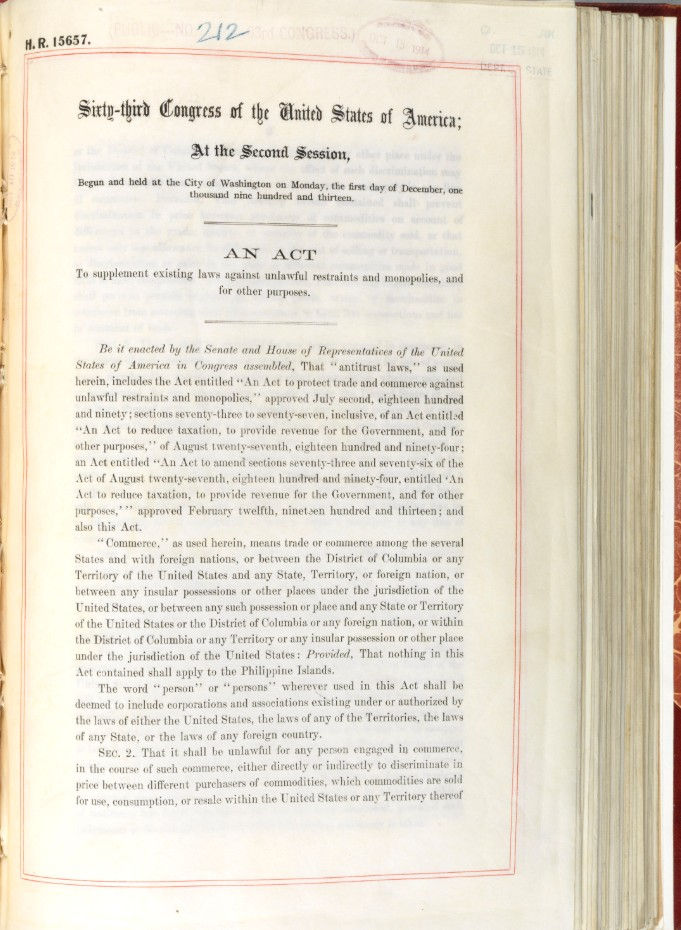
The Clayton Antitrust Act strengthened antitrust law and helped protect labor organizing by clarifying that unions were not illegal combinations in restraint of trade. Although not specifically aimed at Hollywood, it became part of the broader legal framework surrounding monopolies, labor, and collective action.
United States Congress. An Act of October 15, 1914, Public Law 63-212, 38 STAT 730, to Supplement Existing Laws Against Unlawful Restraints and Monopolies, and for Other Purposes (Clayton Antitrust Act of 1914). 63rd Cong., 2nd Session.
1933 Bank Holiday

The 1933 Bank Holiday affected industries across the country, including Hollywood, by restricting access to bank funds during the Great Depression. For studios already facing economic strain, the crisis contributed to production slowdowns and financial uncertainty.
U.S. President. Proclamation. “Bank Holiday, March 6-9, 1933, Proclamation 2039 of March 5, 1933.”
National Industrial Recovery Act, 1933

The National Industrial Recovery Act attempted to stabilize American industry during the Great Depression and included protections for workers’ rights to organize and bargain collectively. Its influence helped shape early New Deal labor politics, even as the law later became controversial.
United States Congress. An Act of June 16, 1933, Public Law 73-67, 48 STAT 195, to Encourage National Industrial Recovery, to Foster Fair Compensation, and to Provide for the Construction of Certain Useful Public Works, and for Other Purposes (National Industrial Recovery Act). 73rd Cong.
Wagner Act, 1935

The National Labor Relations Act, commonly known as the Wagner Act, protected workers’ rights to organize, bargain collectively, and engage in collective action such as strikes. For Hollywood workers, it helped create a stronger legal foundation for union organizing.
United States Congress. Act of July 5, 1935, Public Law 74-198, 49 Stat 449, to Diminish the Causes of Labor Disputes Burdening or Obstructing Interstate and Foreign Commerce, to Create a National Labor Relations Board, and for Other Purposes (National Labor Relations Act / Wagner Act). 74th Cong.
Fair Labor Standards Act, 1938

The Fair Labor Standards Act established national standards for minimum wage, overtime pay, and child labor protections. These reforms helped define basic labor protections that also affected workers in the film and entertainment industries.
United States Congress. Fair Labor Standards Act of 1938. Public Law 75-718, 52 Stat. 1060. 75th Cong., 3rd Session, June 25, 1938. FRASER, Federal Reserve Bank of St. Louis.
Taft-Hartley Act, 1947

Passed after major postwar labor unrest, the Taft-Hartley Act restricted union power by limiting practices such as secondary boycotts, jurisdictional strikes, and closed shops. Its non-communist affidavit requirement also reflected the growing anti-communist politics of the Cold War era.
United States Congress. Act of June 23, 1947 (“Taft-Hartley Act”) Public Law 80-101, 61 STAT 136, “to amend the National Labor Relations Act, to provide additional facilities for the equalize legal disputes affecting commerce, to equalize legal responsibilities of labor unions and employers, and for other purposes.” 80th Cong.
United States v. Paramount Pictures, Inc., 1948

This landmark antitrust case challenged the major studios’ control over film production, distribution, and exhibition. By forcing studios to divest their theater chains, the Paramount decision helped weaken the old Hollywood studio system and reshape industry structure.
United States v. Paramount Pictures, Inc., 334 U.S. 131 (1948).
Context Note: Postwar Labor Backlash
“I know of nothing which outrages the American people more than a strike because two unions can’t agree on who should do what work...”
In this 1946 address, Eric Johnston, president of the Motion Picture Association, condemned the jurisdictional strikes that paralyzed major studios. His comments reflected a growing postwar public and political backlash against organized labor. This sentiment helped clear the path for the Labor Management Relations Act of 1947 (Taft-Hartley Act) which significantly curtailed union power and outlawed secondary boycotts and jurisdictional strikes nationwide.
Eric Johnston, “Utopia is Production,” Johnston, Eric Speeches from the Association of Motion Picture and Television Producers (AMPTP) records, July 23, 1946, Association of Motion Picture and Television Producers (AMPTP) records, Margaret Herrick Library, Academy of Motion Picture Arts and Sciences.